
Retreat Case Study
The leadership team of a professional association recognized a need to invest in the next generation of their field. At the beginning and end of their two-year fellowship, the inaugural cohort participated in professional development retreats that incorporated photovoice activities. The process helped fellows and their mentors who were spread out over North America build and maintain relationships, process their experiences, and shape the experience of future cohorts. Subsequently, several participants even incorporated photovoice into their own work.
A Recipe for Flourishing
A group of ten early-career professionals arrived at a retreat center for the opening of their two-year fellowship. The program paired them with late-career mentors. While most of the fellows didn't know one another very well, they did know who their mentors were: they were the big names in their field, the authors on their shelves, the ones whose research they'd already cited. The next two days of the retreat would lay the foundation for the next two years of collaboration between them. The challenge they faced was deepening their relationships and doing their work across distance.
Program leadership knew that a retreat wasn't enough on its own. A fellowship spent mostly on Zoom calls and email can produce colleagues who know one another's work without ever really knowing each other. Photovoice was incorporated into two retreats, sixteen months apart, as an intentional and creative pathway to relationships. Not another agenda to sit through, but something designed specifically to help strangers become colleagues fast.
At the opening retreat, the first activity had nothing to do with credentials. Everyone arrived having already composed photos of the people, places, and everyday details that made up their lives, and spent the first hour in small, rotating groups, using those photos to introduce themselves as people first. A second session posed something deeper: photos and stories of moments when they'd flourished, and moments of real difficulty. During a final photovoice activity, they created a collaborative gallery the whole group could walk through and respond to.
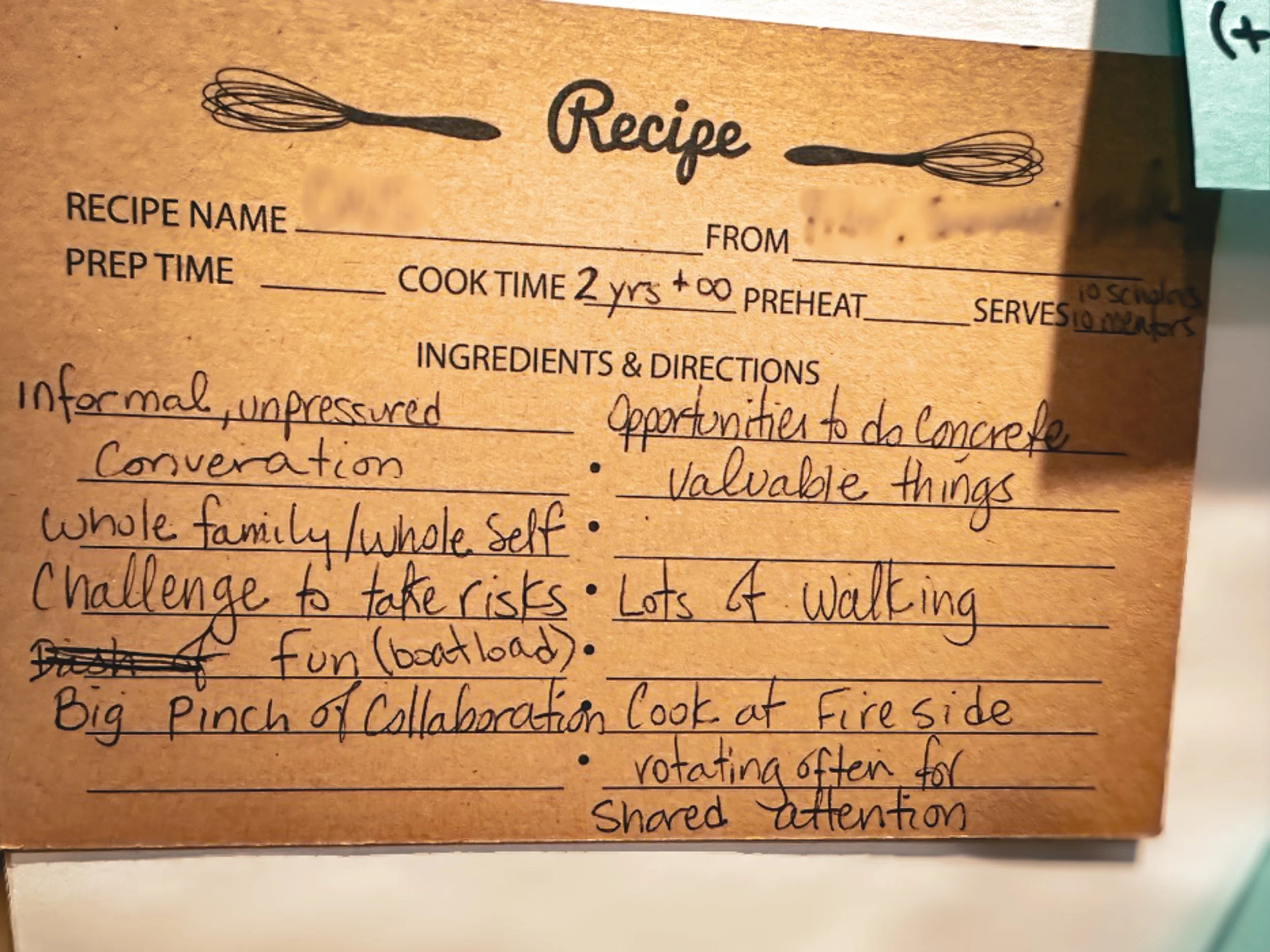
Sixteen months later, the closing retreat asked a different question. What had the fellowship looked like at its best? They'd been collecting photos throughout the fellowship; now it was time to tell their stories. Working in groups, fellows shared their experiences and then distilled what they discovered onto recipe cards: the ingredients, in their own words, for what had made the experience matter.
Three things showed up on almost every card: relationships, the feelings that came with them, and the postures—risk-taking, sitting with uncertainty, letting go of old assumptions—that led to flourishing. Several participants singled out a specific evening at the first retreat, when they gathered around an outdoor fire pit, as the moment that started it all. As it says on one recipe card , “Cook at fire side, rotating often for shared attention.”
"I've never felt this way as a professional. It was a huge gift."
Without that early investment in relationships, this could have been just another fellowship—good mentorship, solid collaboration, colleagues who respected each other's work from a professional distance. The recipe cards from that final retreat showed the impact of visual storytelling directly: participants provided real evidence, through their own lenses, of exactly what had carried them through their two years of professional development. Several fellows even brought what they'd experienced into their own labs, using photovoice to build cultures where people flourish.
Beyond the Frame
Stanford psychologist Geoffrey Cohen has spent years studying what happens to people when a group makes it unmistakably clear that they belong—not through a welcome packet or a mission statement, but through small, repeated signals that someone is genuinely glad they're there. His research finds that belonging isn't a mood; it's a message that has to be sent clearly and consistently for people to receive and believe it. A retreat can't manufacture that message by accident. It must be built purposefully.
That's what these two retreats did. Not with a slogan or a values poster, but with photographs and opportunities for “fire pit” conversations that people were still returning to sixteen months later. The message wasn't subtle, and it wasn't left to chance: you belong here, loud and clear.
Ready to see what this could look like for your team?
Build a workplace culture where teams trust one another more deeply, employees communicate with greater understanding, and everyone collaborates more effectively across differences—that's a culture built through intention, not by accident.